
More Than Just a Game
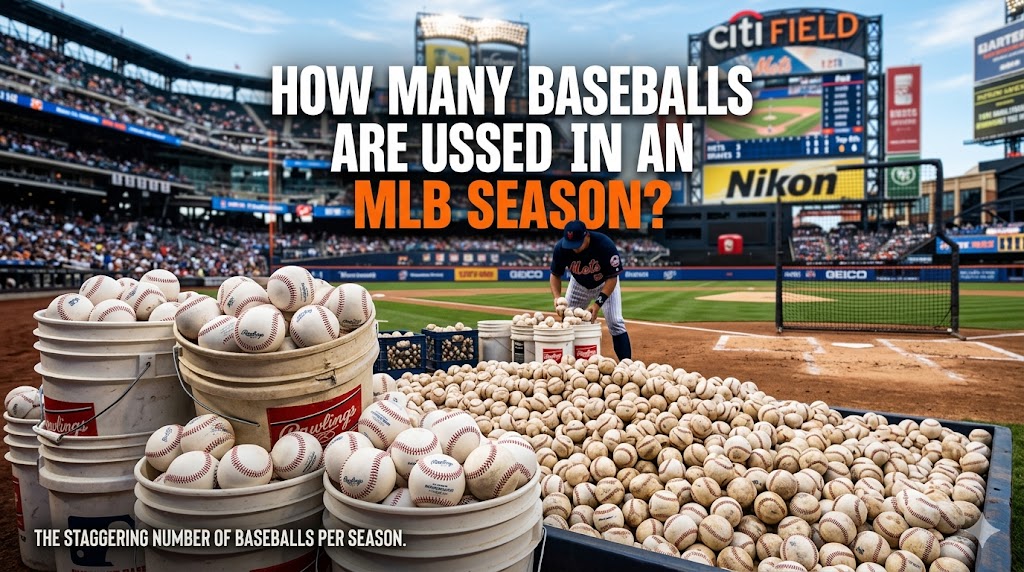
(How Many Baseballs Are Used In A MLB Season) For fans watching from the stands or at home, a Major League Baseball game looks simple: pitch, hit, catch, repeat. But behind the scenes, the MLB machine consumes resources at a staggering rate. If you have ever caught a foul ball or purchased a game-used souvenir, you have held a tiny piece of a massive statistical iceberg.
So, what is the magic number? On average, MLB teams use approximately 8 to 10 dozen baseballs per game. When you multiply that by 2,430 regular-season games (30 teams playing 162 games each), plus the Wild Card, Division Series, Championship Series, and the World Series, the total number of baseballs used in a single MLB season ranges between 900,000 and 1.2 million baseballs.
But why so many? Let’s break down the science, the rules, and the logistics of baseball consumption.
The Baseline: Baseballs Per Game
To understand the season total, we have to look at a single nine-inning game. According to MLB equipment managers and reports from sources like ESPN and The Athletic, the average official Major League game uses between 84 and 120 baseballs.
That breaks down to roughly 7 to 10 baseballs per inning.
Here is why you don’t see the same ball for the whole game:
-
Every time a ball touches the dirt, it gets scuffed. Scuffed balls are harder to see and can move erratically, posing a danger to batters.
-
Foul balls go into the stands. Those balls are rarely returned.
-
Home runs disappear into the crowd.
-
Pitchers demand fresh balls. A pitcher is allowed to request a new baseball whenever he wants—usually every few pitches.
Case Study: During a typical marathon game like a Yankees vs. Red Sox 13-inning battle, the number can swell to over 150 balls.
The Regular Season Math (1,215 Games)
Let’s do the math for the regular season. Remember, there are 30 teams, but two teams play each game. The total number of regular season games is 2,430. However, to calculate baseballs used, we look at “game opportunities.”
The Conservative Estimate:
If each game uses 84 baseballs (7 per inning):
2,430 games × 84 balls = 204,120 baseballs.
The Realistic Estimate:
Because most games use scuffed balls and see fouls, the actual average is closer to 100 balls per game.
2,430 games × 100 balls = 243,000 baseballs.
The “Wet/Dirty” Estimate:
On humid nights or rainy rescheduled games, balls get swapped more often. At 120 balls per game:
2,430 games × 120 balls = 291,600 baseballs.
Wait—aren’t we missing something? Yes. That is just the balls that enter play. It does not count batting practice, bullpen sessions, or infield warm-ups.
The Hidden Consumption: Pre-Game and Practice
For every one baseball used in a live game, a team uses roughly three more behind the scenes.
-
Batting Practice (BP): Before every home game, a team hits 150 to 200 baseballs into the stands or deep into the outfield. Most are not retrieved.
-
Bullpen Pitchers: Starting pitchers warm up with 20-30 balls in the bullpen before they even take the mound.
-
Infield/Outfield Practice: Another 50 balls per team.
The Pre-Game Total:
30 teams × 162 home games = 4,860 home games.
Average 200 practice balls per game = 972,000 baseballs.
Adding it up:
Game balls (245,000) + Practice balls (972,000) = 1,217,000 baseballs per season.
This is the number that most statisticians agree upon: Just over 1.2 million baseballs.
The Postseason and The World Series
The demand for baseballs actually increases in October.
-
Higher Scrutiny: Umpires inspect every ball more carefully in the playoffs. Any imperfection gets the ball tossed.
-
Commemorative Balls: Every Postseason game uses special gold-and-black or postseason-branded balls. For the World Series alone (4 to 7 games), roughly 350 to 500 balls are used.
-
The “Clean Ball” Rule: In cold weather playoff games, balls are kept in humidors. If a ball gets too cold or hard, it is removed.
Postseason Estimate: An additional 15,000 to 20,000 baseballs.
What Happens to All Those Baseballs?
Now that you know how many are used, you might wonder where 1.2 million baseballs go each year. They don’t just vanish.
-
The Fans: Approximately 30% of all baseballs (roughly 300,000) end up in the hands of fans. Foul balls and home runs are yours to keep.
-
The Dugout Buckets: Balls that are slightly scuffed but not dirty are sent to minor league affiliates for practice.
-
Game-Used Memorabilia: Balls from historic at-bats (Aaron Judge’s 62nd home run, etc.) are authenticated and sold for thousands of dollars. On your website, lettermanjacketcustom.com, you might consider a blog about how fans store their valuable memorabilia next to their custom jackets.
-
The Mud Room: Believe it or not, new baseballs are destroyed intentionally. Every ball must be rubbed with a special mud from the Delaware River to remove the shine. Balls that get “over-mudded” are thrown away.
Why This Matters for Your Gear
Why does a custom letterman jacket store care about baseball statistics?
Because baseball is a lifestyle.
The fans who catch those 300,000 foul balls are die-hards. They sit in the bleachers in April when it is 40 degrees and raining. They go to Spring Training in Florida. These fans need high-quality, customized apparel.
At LettermanJacketCustom, we understand that a true fan doesn’t just wear a jersey. They wear a legacy. Our custom wool and leather letterman jackets are designed for the baseball purist—the coach, the player, or the fan who knows that between practice balls and game balls, over a million pieces of history fly through the air every summer.
Conclusion: The 1.2 Million Figure
To answer the original question succinctly: Between spring training, the 162-game regular season, the playoffs, and the World Series, Major League Baseball uses approximately 1.2 million baseballs annually.
That is enough baseballs to stack taller than Mount Everest or fill two Olympic-sized swimming pools. The next time you see a pitcher toss a ball to the umpire for a fresh one, remember: you aren’t watching a waste of resources. You are watching a sport obsessed with perfection, consistency, and tradition.
And speaking of tradition—whether you are heading to Wrigley Field or Yankee Stadium, keep warm in style. Make your own custom statement at LettermanJacketCustom today.
Frequently Asked Questions (FAQ) – Schema Ready
Q: Does the MLB reuse baseballs that are hit into the stands?
A: No. Once a baseball goes into the stands, it is fan property. The MLB does not retrieve or reuse fan-caught baseballs for safety and sanitary reasons.
Q: How much does one MLB baseball cost?
A: Rawlings manufactures the official MLB ball. The league pays roughly 7to10 per ball. With 1.2 million balls used per season, the MLB spends nearly $10 million dollars on baseballs annually.
Q: Do cold weather games use fewer baseballs?
A: No. Cold weather makes baseballs harder and more dangerous to hit. Pitchers complain of numb fingers, so they request fresh balls more frequently, increasing usage.
Q: Where does LettermanJacketCustom ship?
A: We ship custom varsity jackets worldwide, from Little League fields to MLB stadium parking lots.